Reflection on Jamming
The title of my PhD thesis was “Pump up the Jam: Facilitating participant collaboration and agency in creating code-based retro games.” Apart from trying to make it sound exciting, the Jam aspect refers to a metaphor for the kind of learning space that emerged in the research process. This blog post will explain my thinking about Jamming and the underlying model of agency development that I proposed in the PhD process.
Jamming? What are we actually doing here anyway?
I think one of the most valuable questions you can ask is:
I’m not sure exactly what it is we’re doing here or why.
When your normal patterns of understanding the world break down, or you are brought face to face with someone asking you to justify what’s happening, it can start some deep reflection.
One of my PhD supervisors, James Duggan, in response to whether a line of research was worth including in my thesis gave some great guidance. He said: “I suppose it depends on what you want to use your PhD for.” I hadn’t thought of it that way, but it helped. It helped me understand that one of my motivations for undertaking the work was to get a greater understanding of the kind of messy and creatively chaotic learning environment that I had enjoyed in my youth and had strived to recreate in different contexts. Without getting lost in the murky depths of my involvement in free music festivals, environmental campaigning, political social centres, and broader community development work, it’s worth mentioning that this kind of unstructured but shared, project-driven learning was a huge inspiration for my work with families learning how to code games together.
While that experience has been useful in my work at university and research, I have not always been able to effectively draw on that tacit experience to clearly articulate how and why. That sometimes led to situations where, in working in partnership with others, I struggled to explain the motivations and assumptions driving the design and delivery of sessions. This PhD has really helped me to bring those factors into the light.
Jamming - what it is
Let’s start with a practical summary of the process. In trying to describe the learning process that I framed as jamming within my research I have come up with the following features for the about page of my new website at http://jammlabs.org.uk:
- A clear and attractive mission for the project
- A low stress taster session where participants can tinker with a starting project in a way which gives them a lot of feedback and a chance to try before committing
- 4–6 (usually weekly) project sessions providing the chance of sustained engagement
- Choice-based development of the project
- Regular social feedback from peers
- A final showcase event to work towards
- Being part of an ongoing community to share ongoing creations and ask questions after the life of the group project
Well that’s fine and dandy in terms of the practicalities. But it doesn’t really get to the underlying ethos or the processes of developing agency at play. The structural details above feed into a more social and flexible approach to learning. The following section aims to explore those aspects of my PhD findings in a relatively accessible way for fellow practitioners, researchers and parents.
Jamming - how and why are we doing it?
In short, Jamming helps develop agency in particular ways, and it’s fun.
It was a fairly long journey for me to identify agency development as the key feature that I was trying to make happen. I have written more about that earlier journey in my post on choice and messy learning, where I explain how I first began with ideas of autonomy, learner choice and informal learning before arriving at agency as the stronger framing.
As I pulled together the analysis and chapters I identified three main forms of agency that built on each other that I found useful. So I hope you do too. This draws mainly on the work of Matusov1 and Sannino and Hopwood2.
- Instrumental agency: I referred to this as the practical ability to get the coding and creation of game elements done. You need to be able to do that before moving on to the next stage.
- Transformative agency: The process of participants changing and developing the learning environment. For example, participants would choose new features of the game to add, and I would respond by creating relevant resources.
- Relational agency: Once the evolved learning environment is in place and the participants start to take ownership of it, they develop specialisms and more peer learning starts to happen.
There were limitations to my research. While I was able to map these elements of agency to behaviour observed in my video data and journal notes, my interview data did not explore participants’ experience of agency directly. I would like to do more work in this area to check participants’ experience more directly and systematically.
However, from my point of view as a practitioner this appears really valuable as a tool to help explain some of the learning happening in the space and the motivations driving it that may not be apparent from an observer’s point of view, where the activity can easily be read as chaotic.
This motivation was clarified for me in reading the work of Barbara Rogoff, who in her work with Indigenous communities saw something similar at play. Rogoff suggests that observers may misinterpret learning in unfamiliar cultural settings because they look for explicit instruction, overlooking forms of learning embedded in participation in everyday activity3.
My own model of agency development
I know. Isn’t it grand. I’ve got my own model of agency development. I call it relational agency by repertoire blending. I am pretty humble in the way that I propose this in my PhD. There is a lot written about agency and I’m not sure that this model presents anything completely new. However, together with the other aspects of my research I think it is a really useful way of looking at an end goal of a collaborative, informal learning environment. I want to explain it relatively straightforwardly so you can see if you agree.
Relational agency by repertoire blending
We covered relational agency briefly above. In this setting it’s a form of interdependence and participation in a community, and involves collective approaches to problem solving and taking on specialities in the group. One of the sources for these specialities are the home interests of the participants or the skills that they can bring from other settings that they are involved with.
In my research, some of the young people really knew their computer games well. So much so that they could identify and describe the kinds of patterns they found in games they played and bring these into their own designs. Other participants, particularly one family, brought their interest and proficiency in art into the mix. Drawing on Gutiérrez and Jurow’s4 concept of repertoires of practice, we can see these repertoires being imported from other activity systems into the emerging space of the game making activity.
Regular group playtesting was an important feature of each session, where participants would stop working on their games to play and comment on each other’s work. This created a really rich space for exchange of practices and peer learning. The repertoires that had been brought into this space started to blend together to form a new group making culture.
This is important in terms of the learning space being inclusive and fun. Even participants who weren’t gamers in terms of identity were able to forge a new identity for themselves in this evolving space by blending their home interests (e.g. art or storytelling) with new technical or game related practices. One participant who rarely spoke during coding activities became central to playtesting sessions because they were particularly good at identifying level balancing problems and highlighting innovative features that other participants had added to their games.
The social nature of the playtesting made the specialisations within individual and pair activity visible at a community level, thus increasing possibilities for relational agency. As new expertise emerged and was expressed as a form of identity within an individual’s repertoire, it often became available for others to draw on. For example, one participant created a game with over 20 levels, which prompted others to ask them for help on adding levels to their game. Academically speaking, the emerging “relational expertise” helped develop relational agency.
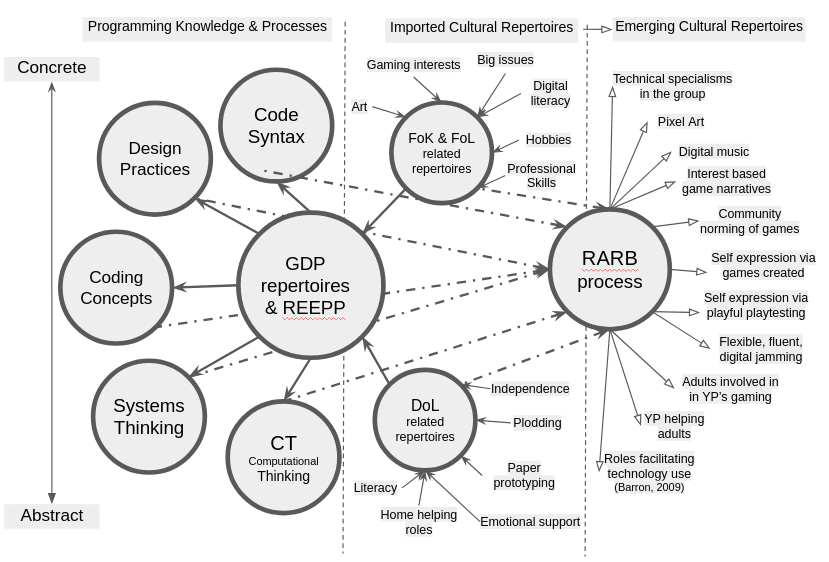
I don’t want to bang on for too long or over explain the diagram above. If you are interested in learning more, have a look at Chapter 7 of my PhD, where I develop this model in more detail. This blog aims to be a sketch of those ideas in practice.
Jamming Metaphor to help communicate ideas of agency and related design concerns
This section reinterprets some of these aspects above, using a metaphor of a musical jam session to describe the complex order within the apparent chaos of a peer, project-based learning environment.
Jamming, a term common in music and theatre, describes responsive, improvised, rapid, and fluid responses to collaborators’ ideas and audience reactions. I think it’s a good way to highlight tensions between freedom and structure in learning spaces. A jamming process does have structure and designed limitations, but equally it includes ways to encourage learners to evolve their own play processes in a group setting that involves both transformational and relational agency.
A jam can relate to the whole session, often referred to as a jam night. For example, there’s one in Hulme, Manchester that has been going in different venues for decades (it’s in the Nia now). Technical infrastructure is provided in the form of drums, microphones, and amps. More established regulars act as facilitators of the musical performance process.
A jam on a micro level can also refer to a musical piece as well as a session. The piece may be based on a familiar, popular genre, such as a slow blues jam. Common jam genres include blues, rock, and jazz. Jam pieces are often variations of songs familiar to the community of musicians (sometimes referred to as standards). The structure, tempo, and key form a base that guides the freer aspects of musical improvisation.
A jam is also a process. For example, within a jam session, bringing your own style to build on existing structures is generally welcomed as long as it blends. The process also features group interaction in the musical jam, where music makers pick up techniques from others. Visual and verbal encouragement is often present in successful jam nights to encourage newcomers. If a jam session is regular, local popular standards emerge. This provides opportunities to hear them played regularly, allows potential future participants to hear different versions, and even sing along in the audience, a useful form of peripheral participation.
Linking this metaphor to the process of game making, our JAMMing sessions are also real events with a real audience for the game (or other product created). In sharing my research in this way, I want to promote the value of an authentic audience, made up partly of peer makers, to motivate the development of repertoires of practice in creative contexts.
JAMMing in this research also balances structure and freedom in the starting point and genre at play. The process of improvisation is based on a prototype of a familiar genre, in this case a platformer game, which is present in the starting game template. I explain this more in my posts on the REEPPP model and how gameplay design patterns became central to the PhD.
JAMMing as a process is about clashing and mixing of styles and culture. The possibility of blending established repertoires with those brought by new players is a motivation that keeps both musical jam sessions fresh, and works in the same way in this kind of creative and collaborative process.
Where next?
These posts can be read in any order, but together they sketch out the wider ideas behind the PhD and the ongoing JAMM Labs work.
This post has focused on jamming as a way of explaining the broader learning culture I was trying to create. Other posts in this series unpack related parts of the process in more detail.
If you want to follow the thread further, you might start with my post on choice and messy learning, which explains the fairly long journey from learner choice and autonomy towards agency as the main framing. You could then read the post on the emergence of gameplay design patterns, which explains how the practical resources at the centre of the project developed. The post on the REEPPP model gives a more practical account of the learning design that came out of this work.
For the fuller academic version, see Chapter 7 of my PhD, where I develop the idea of relational agency by repertoire blending in more detail.
So I hope that answers the question, what are we doing here anyway? Or more likely, it doesn’t fully. But if it offers some useful food for thought, or sparks a conversation about working together, then that’s probably just as valuable. If JAMMing works in this context, it feels worth trying in others, across different forms of creative and collaborative work, including university settings, youth work contexts, community arts projects, family learning, and beyond.
I’ve set up a website to help motivate and report on this work here:
https://jammlabs.org.uk
You can get in contact with me about working together at jamm.labs.tod
Footnotes
-
Matusov, E., von Duyke, K. and Kayumova, S. (2016) “Mapping concepts of agency in educational contexts”, Integrative Psychological and Behavioral Science, 50(3), pp. 420–446. ↩︎
-
Hopwood, N. and Sannino, A. (eds) (2023) Agency and Transformation: Motives, Mediation, and Motion. Cambridge: Cambridge University Press. ↩︎
-
Rogoff, B. (2003) The Cultural Nature of Human Development. Oxford: Oxford University Press, especially pp. 51–58. ↩︎
-
Gutiérrez, K. D. and Jurow, A. S. (2016) “Social design experiments: Toward equity by design”, Journal of the Learning Sciences, 25(4), pp. 565–598. ↩︎