Meeting yourself in the middle - structuring linear manuals for non-linear work
I am writing this blog post as a way of reflecting on the submission of my PhD thesis, and reconnecting with my past practices as a community tech and media educator. One of the ways I am doing this is by reflecting on some of the writing that I tried to squeeze into the thesis but which didn’t quite fit. The following section is one of those, and I want to use it to reconnect to my past work with FLOSS Manuals, a community of writers, educators and artists who create Free manuals for Free Software.
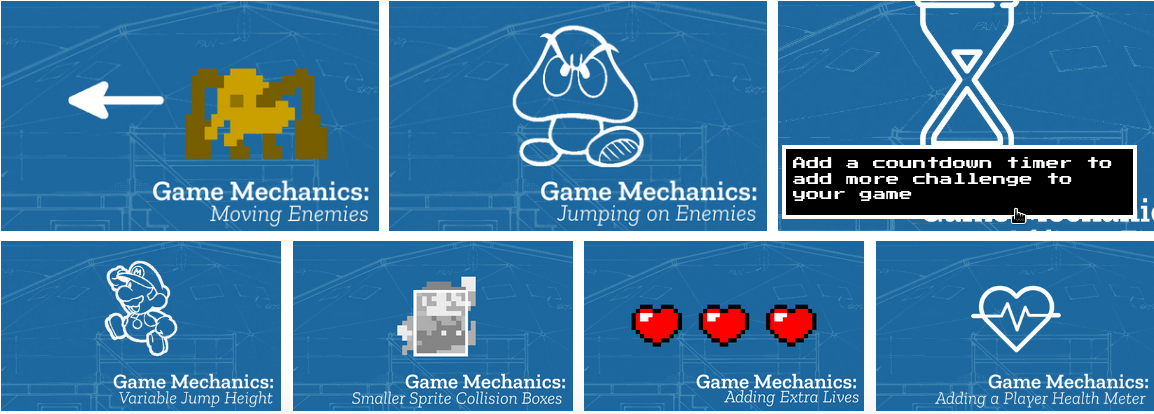
The context is that I had been writing tutorials to support participants in their game making by structuring them around particular features (game design patterns), and including code examples which they could add directly to a starting game template that all students were using as a base. I created a hub, structured around graphical representations of these features, to host both snippets and tutorial instructions. The aim was to make navigation more intuitive and to orient the documentation around participants’ gameplay experience. The figure below shows a screenshot of the webpage created, which served as a menu of GDPs.
Meeting yourself in the middle
As these tutorial-based chapters took the code of the starting template as their starting point, and did not attempt to explain it, they did not fully resolve the issue of participants wanting resources that explained these core constructs and underlying concepts.
In parallel, in response to some participants’ requests for foundational coding knowledge, I created step-by-step chapter resources guiding users to build a core game template structure from first principles1. These chapters were relatively straightforward to write, as they followed a more traditional linear format. There was no choice of pathway involved, or much in the way of creativity. As an adult, I was fairly used to working my way through these kinds of instructions, but I did not expect my young learners to do that.
So in terms of writing the FLOSS Manual, there was a bit of thinking to be done about how best to communicate the different approaches available to the reader. When teaching in person, although this did not fully align with the choice-driven approach, I envisioned this linear format of the first chapters as reinforcement for learning outside of sessions, to use as a foundation for core concepts, which indeed some participants (mostly adults) did take up and use.
However, for those not undertaking the course in person, I wondered how best to describe the relationship between the self-contained mini-tutorial chapters and the step-by-step ones. I wanted to replicate that early, hands-on, engaging experience for people reading the manual and working through it at home.
To resolve this, before the chapters that described how to build the game template from first principles, I added two additional chapters that encouraged readers to first Jump Right In, which linked to a starter game template in a code playground, along with quick activities to make large, visible changes, and another, Choose your own Adventure.
In terms of how to describe this dual process, I named this concept meeting yourself in the middle to represent the possibility of retracing the process of learning from first principles. The key idea here was that after making the game from a template, these foundational chapter resources are available at any time to explain the underlying concepts that the starting template had initially abstracted away. In this sense, the process helps reinforce computing concepts already encountered through play and experimentation. Narratively, these chapters form the equivalent of a prequel for readers interested in the full story.
A Future for non-linear FLOSS Manuals
While most manuals in FLOSS Manuals have been linear, there have also been ones which were more complex in structure. For example, some have been about process, exploration, and a kind of pick-and-mix approach. A good example of this is Digital Foundations, which moves between guided instruction and open-ended experimentation rather than forcing a single path through the material.
This idea of meeting yourself in the middle builds on that tradition. It offers one way of structuring manuals for non-linear pedagogical approaches, especially where learners are working from a shared starting project and choosing from a menu of features to develop it further.
If the pedagogy has the potential to be messy in a good way, a creative kind of chaos, then perhaps the book structure should mirror that as well. The challenge is not to get rid of the messiness, but to structure the manual in a way that fits within the limits of a printable document while still making sense to the reader. This approach is one attempt to reconcile those two things.
The title of the chapter “Choose your own Adventure”, where I outline how the reader may go about interacting with the manual in a way that suits them, is a nod to the work of R. A. Montgomery, who wrote the original Choose Your Own Adventure books (see figure below). This approach offers a playful way to let readers of the manual know that they are encouraged to take a personal and experimental approach to how they interact with it.

If you are working on a project that might suit this kind of structure, it would be great to explore it together. You can find out how to get involved at about.flossmanuals.org.uk.